


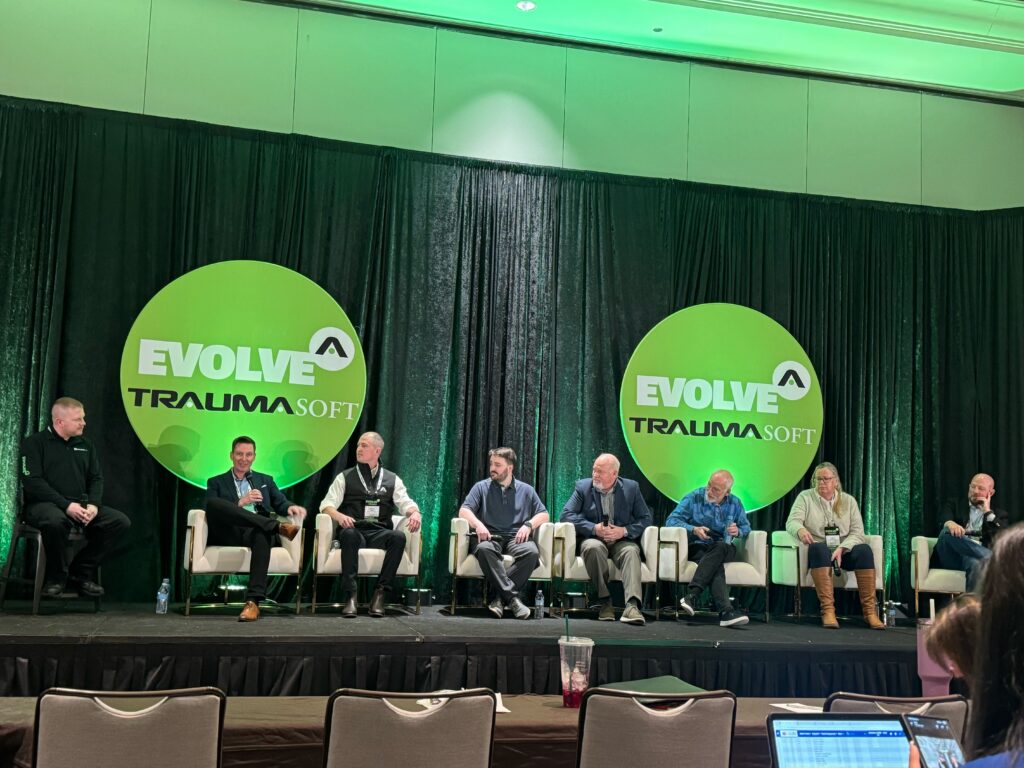
Early February, Lindsay Tamchin and I had the pleasure of attending Traumasoft Evolve 2026 in Orlando. We joined EMS leaders and technology partners to share, learn, and hear what’s next in the rapidly shifting EMS landscape. This conference was a great opportunity for us to deepen connections with our Traumasoft-integrated customers, build new relationships with some of the nation’s most innovative EMS agencies, and learn how we can partner more effectively with the team at Traumasoft.
Throughout all the great conversations we got to listen to and be a part of, a consistent theme was clear: EMS agencies and transportation providers are building workflows that make teams more efficient without adding complexity. The exact steps they choose are different. Some are exploring how responsible AI adoption can reduce burnout and improve their data collection, others are strengthening their revenue cycle discipline and the exploring the value of integrating your CAD systems. No matter the choice, industry leaders are all choosing efficiency as the core value in 2026.
Reducing Burnout Through AI Adoption
AI was a hot topic on the agenda, but one theme was clear: Implementation would only be beneficial if it eased workloads. Adding AI into existing workflows should reduce friction for your already busy team, not add extra steps.
For this reason, leaders must evaluate AI use critically if they wish to implement it in their operations. They should review questions like:
- Does using AI improve documentation quality?
- Does it meaningfully lower administrative burden without adding complexity?
- Will implementing AI improve overall job satisfaction?
Expectations for AI are high, but that means the benefits for your team must be as well. As payroll reaches an unprecedented percentage of EMS agency revenue, and attracting and retaining talent is more critical than ever, leaders must be focused on wellness and ensuring that EMS agencies take care of employees’ whole selves. AI has the potential to vastly reduce burnout, but only if applied responsibly.
Traumasoft Acquires Huly, Advancing a Market-First AI Strategy for the EMS Industry
A major development reinforcing this responsible adoption is Traumasoft’s acquisition of Huly. This move centers on enhancing documentation accuracy at the point of care in order to improve cash flow, accuracy, and staff productivity.
Huly’s technology focus on high-friction areas like pre-billing, quality assurance/quality improvement (QA/QI), and payroll. This focus on quality can help teams minimize missing or inconsistent patient information before errors might be made. When documentation is strengthened in real time, teams can spend less time chasing down corrections and more time focused on patient care.
Data Accuracy Is Directly Tied to Revenue
AI may support documentation, but data discipline remains the foundation. We got to sit in on several thoughtful discussions with industry leaders about doing more with the data their systems already generate. When information is structured, reliable, and accessible, it becomes a key driver of both performance and revenue protection.
One EMS leader from NYU Langone shared a powerful example. By analyzing their CAD data, they were able to demonstrate bottlenecks during hospital transfers and use that insight to convince their hospital partner to dedicate an elevator specifically for EMS transports. The result was a transformational eight-minute reduction in response time on every transfer.
Get Every Dollar You Can, Save Every Dollar You Can
In a landscape where the reimbursement picture is rapidly changing, staying on top of revenue cycle management is more important than ever. Payer scrutiny is increasing and documentation requirements are tightening. Agencies cannot afford to miss charges.
Getting every dollar means ensuring that data coming in from the hospital and ePCR systems is clean, complete, and ready to be billed. Small documentation gaps or mismatched data fields may seem insignificant at first, but at scale they translate into delayed payments and extra work on people’s plates. When margins are low and volume is high, your team must remain at the top of their game in order to work effectively. Ensuring your Traumasoft CAD is directly integrated into a hospital’s EHR can pull over relevant patient data automatically, eliminating human error and erasing information gaps.
Integration and Streamlined Workflows Are Foundational to Operational Efficiency
Across the EMS industry, disconnected systems continue to create unnecessary work. Manual ride updates, constant phone calls, and duplicated data entry pull dispatchers away from active ride booking and slow everything downstream. The push now is toward tighter system alignment. When CAD data flows automatically, agencies reduce friction, improve response times, and give dispatch teams back valuable time.
Efficiency gains don’t always come from big changes. Even small workflow improvements—like reducing handoffs or eliminating redundant updates—can shave minutes off transports and create meaningful operational breathing room.
The Necessity of Integrating with an Online Ride Booking Portal
Many of the pain points EMS agencies are trying to solve—dispatcher overload, manual status checks, and inconsistent data—stem from disconnected systems. Capturing ride requests from your health system partners in one central platform will eliminate any disconnected workflows and reduce the number of missed booking opportunities.
When that same ride booking portal can be integrated with your Traumasoft CAD, it will help reduce unnecessary phone calls, keeps ride statuses up to date automatically, and allows your dispatchers to stay focused on live operations. With the right portal, agencies can start maximizing revenue while simplifying day-to-day workflows.
Choosing a ride booking portal can be complicated. We put together a short list of requirements that any prospective partner should meet:
- Integrate seamlessly with your Traumasoft CAD, but also with health systems’ EMR. Eliminating information gaps is critical to growing ride volume.
- Pass health system IT reviews with flying colors. SOC 2 Type II compliance is recommended if you want to follow security best-practices.
- Accurate and transparent reporting to ensure you are delivering on SLAs and continually improving efficiency.
- User-friendly interface and robust change management strategies to drive health system ride booker adoption for guaranteed long-term success.
Where the EMS Industry Is Headed
Traumasoft Evolve reinforces something important: EMS agencies are not standing still. They are simplifying workflows and investing in systems that protect both performance and financial stability. Conversations around AI, data integrity, revenue discipline, and CAD integrations reflect an industry focused on efficiency.
If you’re interested in streamlining your operations with an online ride booking portal, but still don’t know where or how to start, Roundtrip is here to help.

Sze Hui, CSPO has spent over 8 years in the healthcare industry, leading efforts to optimize workflows and eliminate copy/paste through data interoperability and integrations. As a Solutions Architect, Sze guides health systems through the technical implementation process, bringing data flow and business process together in a cohesive and seamless way.