


Surge planning often fails for a mundane reason: most health systems can’t see enough of their own operation to know a surge is forming until it arrives. Capacity teams learn about an ED spike the same way everyone else does, once wait times climb and admissions back up. By then the response is improvised, when it could have been a plan already in motion.
Transportation falls into that blind spot for a structural reason. It usually runs outside the hospital’s own systems, arranged over the phone between case managers and ride providers. So even health systems that have solved bed and discharge visibility often can’t see when a patient’s ride will actually show up. That gap surfaces somewhere else; as an unexplained length-of-stay outlier or an optimistic surge plan built on the assumption that discharges would always happen on time.
Getting ahead of surge means building one coordinated view across the whole system from the start. With that view, capacity teams can see a surge forming while there’s still time to act on it. It’s also the only way upcoming federal reporting requirements become confirmation of what an organization already knows about itself, instead of a scramble to catch up. The Hospital Capacity Management Consortium (HCMC) hosted its inaugural Hospital Capacity Management Leadership Forum this year, where that argument kept showing session after session.
The Five Stages of Hospital Throughput Maturity
Most capacity teams are working with a visibility problem long before it ever becomes a capacity problem. Fragmented views of bed status, transfer requests, and discharge readiness, spread across systems that don’t talk to each other. This sort of organizational structure force nearly every decision to be made reactively instead of proactively.
Jessica Crum, founder and principal advisor of Roshira Insights (and former Executive Director of Epic Applications and Transfer Operations at Forrest Health), has seen the same pattern at nearly every health system she’s worked with — nobody has a real-time read on what’s happening in the ED, virtual bed capacity is fragmented across units, and case tracking either doesn’t exist or lives in spreadsheets that don’t talk to each other. Without visibility, transfers slow down and length of stay climbs, which drags down quality scores and burns out the staff left holding the pieces.
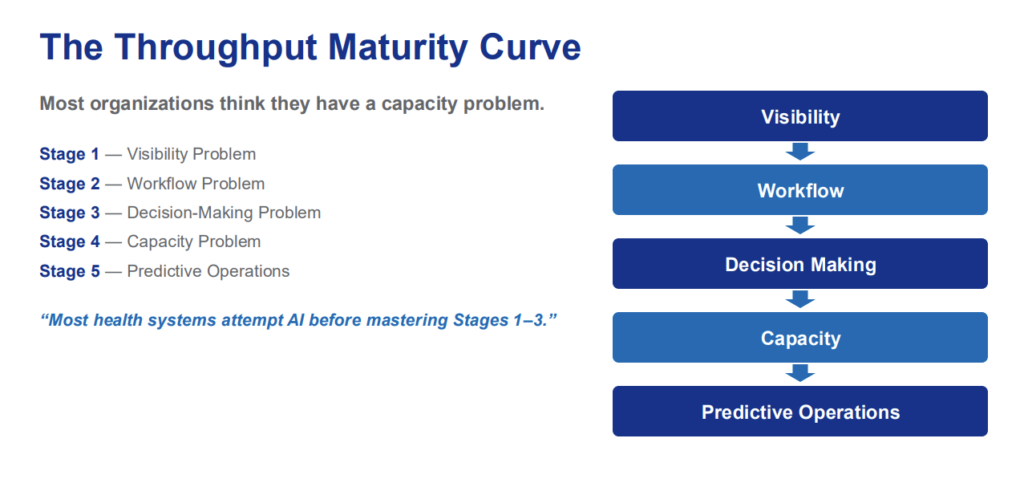
To break that cycle, Crum laid out a throughput maturity curve that most health systems have not evaluated against:
- Stage 1: Visibility – If leadership can’t see what’s happening across the full system, nothing downstream can be fixed with full confidence.
- Stage Two, Workflow standardization: Without a shared definition of how a transfer or bed request moves through the system, every facility invents its own process and the data never lines up.
- Stage Three, Decision-making and accountability: Someone has to own the call. Corporate mandates and facility-level “guided autonomy” tend to talk past each other unless one clear decision-maker is named.
- Stage Four, Capacity: After your organization has achieved stage four, an organization finally understands its true capacity, rather than working off guesses, and can start fixing the bottlenecks instead of reactively chasing symptoms.
- Stage Five, Predictive Operations: Once true capacity is understood, an organization can move from firefighting to real predictive planning, forecasting discharges and hourly ED surges ahead of time instead of reacting to them as they happen.
Crum grounds those five stages in one specific moment from her own work: closing the loop at the end of a transfer. “You can have a facilitated transfer and no transportation set up because nobody asks the question,” she says. Governance stops at bed placement and transfer approval, and following the patient all the way out the door never becomes anyone’s explicit job. It’s the same disconnect Stage Three names, corporate mandates and facility-level guided autonomy talking past each other, just playing out on the transportation side instead of the bed side. Transportation rarely has one clear owner asking that closing question, which is exactly why it’s the piece most likely to get skipped.
Building an Integrated Transfer and Bed Planning Model
Crum’s prescription for the first two stages was a single integrated model, staffed by cross-trained coordinators who understand both bed planning and transfer operations instead of treating them as separate departments. In one multi-hospital transfer center she led, referrals grew 30 percent, completed transfers rose 33 percent, and completion rates improved 13 percent, with growth as high as 70 percent in the initiative’s first year alone.
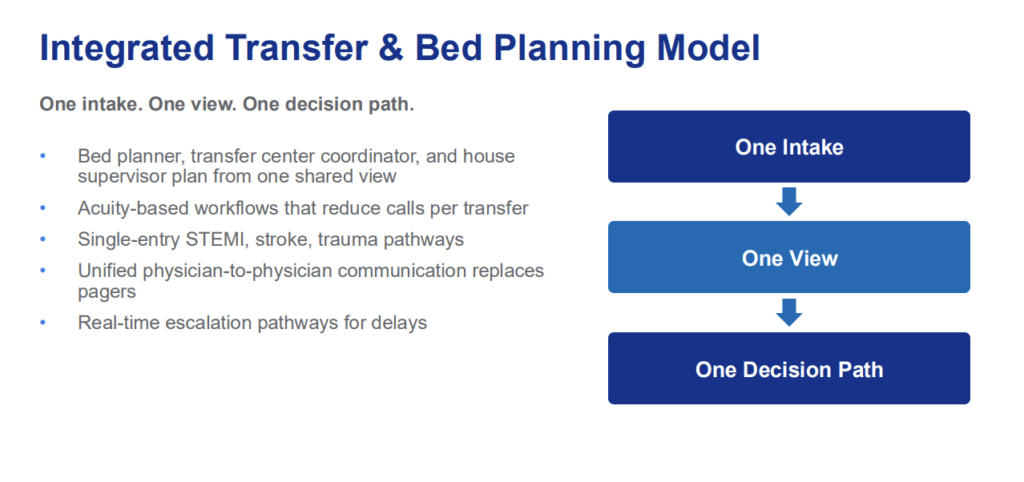
Ownership of the decision to move a patient isn’t the same as ownership of whether that movement actually happens on time. A coordinated bed planning system that stops at discharge readiness accounts for only half the patient’s journey, because plenty of organizations have someone who owns the discharge plan or the transfer center, and far fewer have someone accountable for whether the ride actually shows up when it’s supposed to. Transportation needs the same clear ownership Crum described for bed decisions. One person or team responsible for knowing when a ride is booked, when it’s delayed, and when that delay is about to become tomorrow’s bed shortage.
Predictive Discharge Modeling: A Capacity Management Tool Hospitals Are Missing
A team can watch a surge form in real time and still have no process for deciding what to do about it. That’s the gap between Stage One visibility and the decision-making Crum describes at Stage Three, and it’s where most capacity programs stall out. Mohan Giridharadas, Founder & CEO of LeanTaaS, tackled that harder problem directly in his session on predictive modeling for discharge timing. He notes that a model that’s 99 percent accurate can still fall short if the 1 percent it misses is a high-acuity patient whose delayed discharge cascades into a blocked bed. He described building an expected date of discharge model that runs alongside physician judgment rather than replacing it, tracking every override so the model keeps learning from the cases where a physician’s read on the patient beat the algorithm’s.
Health systems have often tried to solve capacity problems by throwing more resources at them, the same way a city adds lanes to a freeway without addressing the traffic pattern underneath. Giridharadas’s model takes the opposite approach: instead of expanding capacity to absorb whatever happens, it forecasts what’s coming, giving a team enough runway to act before the cascade he described actually starts.
Isolated Throughput Fixes Just Move the Bottleneck
Once a team has visibility into a piece of the patient journey — whether that’s bed status or discharge readiness — the instinct is to optimize that piece as hard as possible. This is where throughput initiatives often go wrong. According to the Institute for Healthcare Improvement, a hospital is an interdependent system, and optimizing one unit in isolation can make the whole system worse. Transportation follows the same rule. Speeding up a discharge lounge that has no idea when transportation will arrive just relocates the bottleneck instead of closing it. Mature systems watch how every piece connects to the next, rather than isolating fixes to just one section.
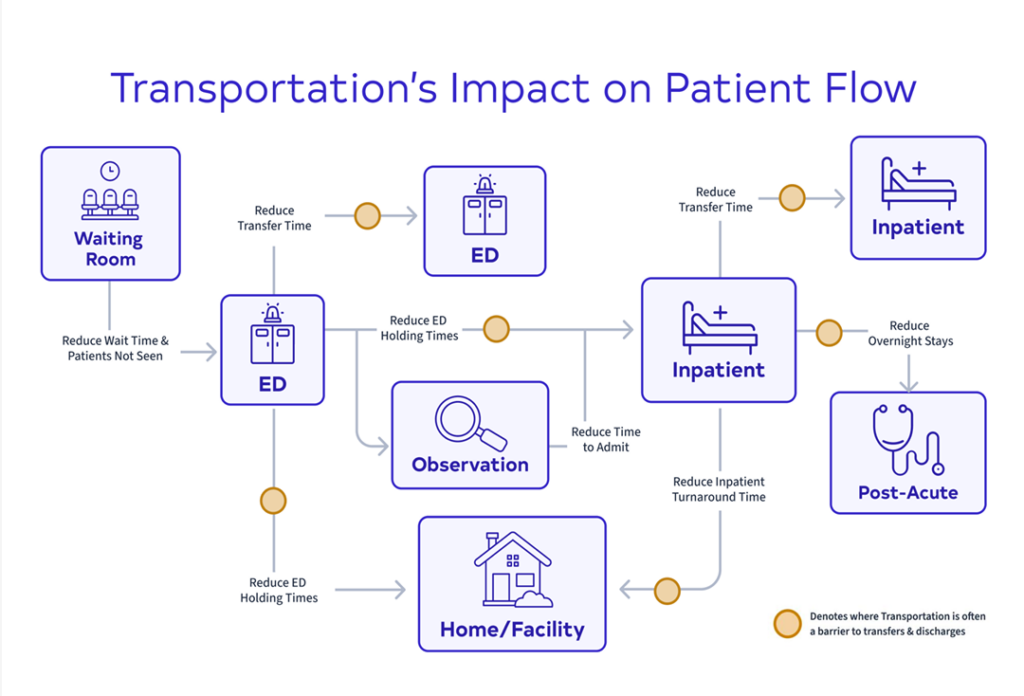
That same pattern plays out across the entire patient journey, from the ED to observation or inpatient care, and inpatient care to post-acute or discharge; at multiple handoffs, transportation surfaces as the barrier. A hospital that gets the clinical care right can still watch its workflow fail if transportation isn’t given the same forethought as the rest of the patient’s care. It’s easy to evaluate each part of the process and propose isolated fixes, but reviewing the workflow holistically is what actually drives improvement.
If your team already has visibility into beds and discharges, transportation is the next place to focus.
Roundtrip’s own Transportation Maturity Model helps health systems evaluate their current maturity and identify the parts of their transportation program that may not have full visibility. Combined with throughput maturity, it gives your organization the complete picture of exactly where the bottlenecks are. If you’re interested in evaluating your organization’s full transportation maturity, our on-demand webinar The Transportation Maturity Model takes you through the framework in detail, covering how to score your program today and what achieving a more maturity stage can mean for your health system.
Watch the Webinar
ECAT eCQM: What the 2026 OPPS Final Rule Means for Emergency Departments
CMS finalized a new Emergency Care Access and Timeliness (ECAT) electronic clinical quality measure in the 2026 OPPS Final Rule. Voluntary reporting begins in 2027, mandatory reporting follows in 2028, and payment determination is tied to performance starting in 2030.
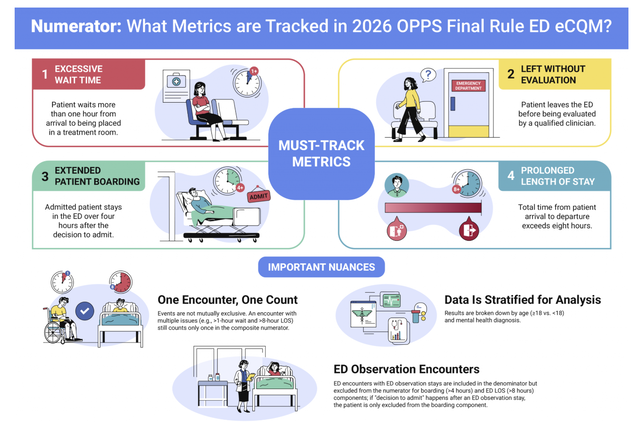
The new ECAT ruling roll four separate metrics into one score and asks whether an ED visit included any quality gap in access or timeliness at all. If so, the encounter counts against the organization once, regardless of how many of the four criteria it triggered. An isolated fix to one time stamp won’t move the score if the rest of the visit is still breaking down elsewhere. Those four criteria are:
- Excessive wait time: More than 60 minutes from arrival to a treatment room, typically a sign of bottlenecks at intake or slowed room turnover from boarding.
- Left without evaluation: Leaving the ED before being seen at all, often moving in parallel with long arrival-to-room times and correlating with higher rates of return visits and subsequent admission.
- Extended boarding: More than four hours from the decision to admit to actual ED departure, designed to push accountability beyond the ED into hospital-wide bed management.
- Prolonged length of stay: More than eight hours of total ED length of stay, an outcome measure that tends to aggregate multiple frictions across the care continuum rather than pointing to a single cause.
Which ECAT Metrics Does Patient Transportation Affect?
Two of those four metrics, extended boarding and prolonged length of stay, are shaped by how fast and reliably a patient can actually be moved. Every hour a patient waits in the ED after being admitted, whether that wait is for a bed or a transfer, counts against the boarding threshold. An ambulance that takes an hour to arrive after being called shows up in this system only as a slow ED, since the reporting has no way to see past the time stamp to the reason behind it.
Prolonged length of stay works the same way from the other direction — an eight-hour visit is nearly triple the average, and transfer friction, an unreliable ETA, a patient who isn’t ready when the ride shows up, sits right alongside consult delays and behavioral health placement as one of the recognized drivers behind it. An organization without real-time visibility into discharge and transportation data won’t know it’s at risk of tripping either threshold until the quarterly report says so, well after the encounter that mattered has closed.
Discharge and transportation data belong in the same coordinated view as bed planning and ED throughput, not in a separate system checked later. That’s what closes the visibility gap before it becomes a compliance problem. Organizations that wait until 2027 to build that visibility leaves almost no runway before mandatory reporting and payment stakes arrive.
Capacity Management Starts With Transportation Visibility
Surge planning, discharge prediction, and federal reporting all come back to the same starting point, an organization can’t manage what it can’t see. With ECAT reporting on a fixed timeline and payment tied to it by 2030, that operational maxim now carries a compliance clock alongside its maturity value. The organizations already treating transportation as part of their capacity data, rather than a vendor relationship managed separately, are the ones for whom ECAT reporting will feel like confirmation instead of a scramble. Health systems that build visibility now, before the mandate forces their hand, get to choose how they respond.
If transportation visibility is the gap standing between your organization and a more mature command center, Roundtrip can help. Schedule a demo to see how real-time transportation data drives the rest of your throughput strategy.

Lindsay (Tsai) Tamchin is the Chief Revenue Officer at Roundtrip. She leads all revenue-generating activities at the company including marketing, business development, sales, and account management. Since joining in 2017, she has led the efforts to secure 85+ contracts across the country. She attended the University of Pennsylvania where she received her BSE in Materials Science Engineering and a minor in Engineering Entrepreneurship.